NYC bus advertising is sold by OUTFRONT Media, the MTA's advertising concessionaire for subways, buses and commuter rail. Its New York media kit, revised 10 August 2026, lists twelve bus formats, from a 30 by 144 inch King to a full wrap. OUTFRONT publishes no rates; Blue Line Media estimates $1,000 to $10,000 per exterior display per four weeks.
A bus buy in New York is three decisions that national rate cards fold into one. The first is the unit, because "King" covers three different sizes here and some units only run in some boroughs. The second is coverage, which the kit sells by borough and, for wraps, by depot rather than by route. The third is the creative, which has to clear an MTA policy that is stricter than the sign rules on the street the bus drives down. This page takes them in that order, then sets out what the published ranges are worth and what to send a seller.
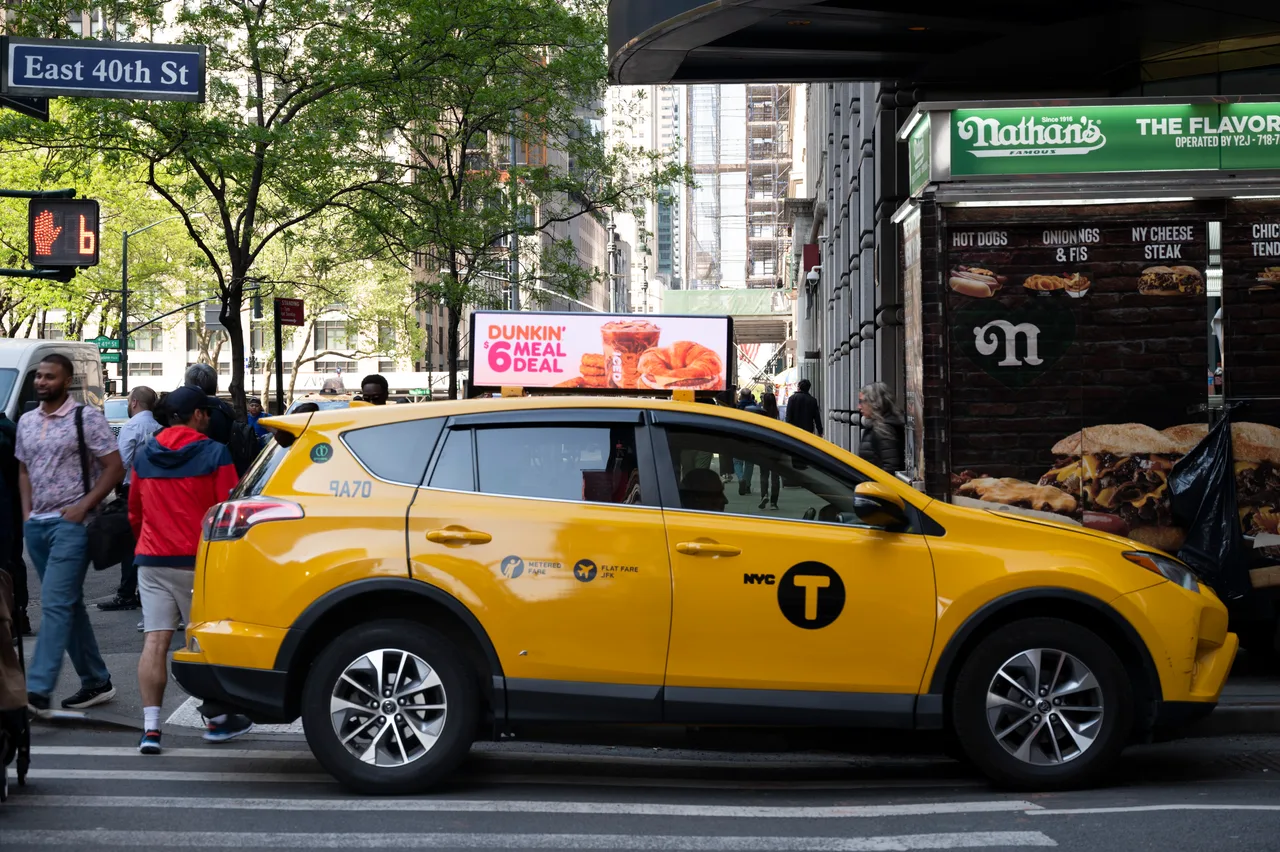
A Dunkin' digital taxi top at the East 40th Street crosswalk, Manhattan. This site's archive holds no photograph of an MTA bus: the frame shows the street-level moving format compared further down, not bus inventory. Campaign photograph from an operator's archive, used with permission.
Who Sells Advertising on New York City Buses?
OUTFRONT Media. The MTA's advertising page sends anyone who wants space on subways, buses, stations or commuter rail to OUTFRONT, and sends billboard buyers on MTA property to Clear Channel Outdoor (MTA, Advertising and activations, retrieved 14 September 2026). The agreement behind it is public because OUTFRONT is a listed company: its annual report for 2025 describes an Advertising License Agreement with the MTA effective 1 November 2017, whose initial ten-year term was extended in July 2021 to a 13-year base term with a five-year option (OUTFRONT Media, Form 10-K for 2025). There is no second bus vendor to bid against. Marketplaces and resellers that list New York bus media are buying the same inventory through OUTFRONT.
The shelter the bus stops at is a different asset with a different owner. New York's bus stop shelters belong to the city's Coordinated Street Furniture Franchise, which is "managed by JCDecaux pursuant to a franchise agreement with NYC DOT" (NYC DOT, Street Design Manual, retrieved 14 October 2026). JCDecaux lists 2,800 or more shelter locations across all five boroughs, 525 digital screens and more than 5,160 backlit panels (JCDecaux North America, NYC bus shelter advertising, retrieved 14 October 2026). A plan that wants the bus and the stop is two contracts, two creative reviews and two invoices.
What Bus Ad Formats Can You Buy in New York?
The bus section of OUTFRONT's New York media kit, last revised 10 August 2026, lists twelve formats on its overview page and gives the front Headlight a page of its own. It prints a size and a coverage list for each unit and no prices. The table below is read from it unit by unit, with the Brand Bus beside the interior card it shares a page with; where the kit says "various sizes", so does the table.
| Unit | Where it sits | Size as published | Boroughs listed |
|---|---|---|---|
| Bus King | Side panel | 30 in high by 144 in wide; headliner, extension or L-side optional | All five |
| 30x215 | Side panel | 30 in by 215 in; headliner, extension or L-side optional | All five |
| Super King | Side panel | 30 in by 240 in; headliner, extension or L-side optional | Manhattan only |
| Ultra Super King | Side, large format | Various sizes | Manhattan, Brooklyn, the Bronx, Queens |
| Ultra Super King Duo | Both sides of a 60-foot articulated bus | Various sizes; template after contract | Manhattan, Brooklyn, the Bronx, Queens |
| Kong | Side panel | Various sizes; headliner or window extension optional | Brooklyn, Queens, the Bronx, Staten Island |
| Queen | Side panel | 30 in by 88 in | Manhattan (the kit's text also names routes in the Bronx) |
| Bus Tail | Rear | 17.5 in by 50 in | All five |
| The Franklin | Rear, upper and lower panels together | Upper 22 in by 70 in; lower 15 in by 70 in | Manhattan, Brooklyn, Queens |
| Headlight | Front, one advertiser | 19.25 in by 44 in, or 17.5 in by 28.5 in | All five |
| Bus Wrap | Full exterior, street and curb sides, one advertiser | Varies by bus type; template after contract | Systemwide; depot-based targeting available |
| Interior Bus Card | Inside, above the windows | 11 in by 46 in; also sold as a Brand Bus | All five |
Specifications from the OUTFRONT Media New York media kit (PDF, last revised 10 August 2026), retrieved 14 October 2026. Sizes are height by width, in inches, as the kit prints them.
"King" Is Three Sizes in One Kit
National rate cards treat the King as one unit, and outside New York it usually is: 30 by 144 inches. OUTFRONT's New York kit sells that size, then a 30 by 215 and a 30 by 240 Super King on the same side of the bus, each of which can take a headliner along the roofline and an extension or L-side beyond the panel. Creative built for a 144-inch King and resized for a Super King is a different layout, not a stretched one. Fix the unit before the agency starts the artwork.
Coverage Is Sold by Borough, Not by Route
The kit publishes coverage for each format as a list of boroughs, and those lists are not the same. A Super King runs in Manhattan only. A Kong runs everywhere except Manhattan, which the kit presents as its way to reach "neighborhood routes" in Brooklyn, Queens, the Bronx and Staten Island. A wrap is listed as systemwide, with "depot-based targeting available". The kit publishes no route list. A plan built around one corridor should ask the seller which depots run the buses on that corridor and how many of the units bought will be on them, then write the answer into the order.
How Much Does NYC Bus Advertising Cost?
OUTFRONT does not publish a rate. Its rates page says they are "based on factors including the number of units and markets purchased, the coverage and duration of your campaign, time of year, and other market conditions" (OUTFRONT Media, Rates, retrieved 14 October 2026). The only New York bus figures in print come from a reseller.
The ranges below are market-level figures compiled from publicly published vendor and industry sources. They are not quotes, and they are not the rates of any single network. Always get a written quote before budgeting.
| Unit | Published range, per display per four weeks | Publisher and basis |
|---|---|---|
| Bus exterior | $1,000 to $10,000 | Blue Line Media, New York City metro page, "average per display per 4 weeks" |
| Bus interior | $40 to $95 | Same page |
| Bus stop shelter | $1,300 to $6,500 | Same page; the shelters are JCDecaux's, not the MTA's |
| Bus exterior, national | $500 to $900 | Blue Line Media, national transit rate card |
Read from Blue Line Media, New York City metro area bus advertising and Blue Line Media, transit advertising, both retrieved 14 October 2026. The New York page states that "certain minimum purchase requirements apply" without naming them, gives no method for the ranges, and carries a notice that some of its information "may be AI-generated". Its exterior band covers every outside unit in one line, a factor of ten, which is the honest width of a figure that does not say which unit it priced. The same page lists a double-decker sightseeing bus at $20,000 to $35,000; that is a private tour operator's vehicle, not an MTA bus, and is left out of the table.
How Many People Ride New York City Buses?
The MTA's 2025 ridership page puts its buses at 442 million rides for the year. Its New York City Transit table on the same page shows 352,146,093; the difference is the routes run by the MTA Bus Company (MTA, Subway and bus ridership for 2025, retrieved 14 September 2026). Either figure counts boardings: one person riding to work and back is two.
Riders Are the Smaller Audience for an Exterior Unit
A King, a Tail or a wrap is read by the people outside the bus: drivers behind it, pedestrians at the crossing, the queue at the stop. Ridership says nothing about them. Only the interior card's audience is the rider. Ask the seller for the audience estimate on the specific units and flight, ask whether it is a Geopath impression figure or a vendor's own count, and compare plans on the same basis. A rider total quoted against an exterior King is answering a different question.
What Will the MTA Refuse to Run on a Bus?
The same things it refuses in the subway, because one policy covers the property. The MTA Advertising Policy effective 25 June 2025 declares the advertising space "a non-public forum", prohibits political advertising and anything that "prominently or predominantly supports, opposes, or comments on" government action or public policy, and bars tobacco, nicotine, cannabis, profanity and sexually oriented products and services (MTA Advertising Policy, PDF, read 14 September 2026).
Alcohol is prohibited by default, and the exceptions in section IV.D are narrow. Digital formats inside stations, cars and buses may carry it only outside "6 a.m. to 8 a.m. and 2 p.m. to 5 p.m. on weekdays when school is in session", and may not be targeted to a particular community. None of the carve-outs, as read on 14 September 2026, names a fixed exterior bus format, so a beer King or a spirits wrap falls under the default prohibition. The policy also states that "the advertising contractor has no authority to reject an advertisement on behalf of the MTA": OUTFRONT screens the creative, but doubtful cases go to the MTA's review, and the review time belongs in the flight plan.
How Do You Reach the Same Streets Without a Bus?
With a format that moves on its own schedule rather than a route's. Firefly sells GPS-enabled digital tops on taxis and rideshare vehicles in New York, scheduled by neighbourhood, time of day and day of week, plus static tops and wraps; SOMO sells digital tops on yellow taxis; resellers such as Blue Line Media list taxi tops alongside bus media. A bus panel goes wherever its bus runs for the length of the flight; a digital top can be weighted toward the blocks and hours a plan names. The two are compared on reach through the corridors that matter to the brief, not on a like-for-like CPM, because a top's delivery is a GPS play log read against modelled traffic and a bus panel's is an audience estimate. The taxi side is set out in detail on the New York taxi advertising page, and the subway, which the same concessionaire sells, on the NYC subway advertising guide.
How Do You Buy NYC Bus Advertising?
- Name the boroughs first. Unit availability differs by borough, so the borough list decides which units are on the table.
- Pick the unit family. Side panel, rear, front, interior or wrap; for a side panel, which of the three King sizes.
- Ask for the depot split. For a corridor plan, how many of the units bought will run from the depots that serve it.
- Ask what the audience figure is. Geopath impressions per unit and flight, or a vendor count, and the same basis for every option.
- Get the template before the artwork. Wraps and Ultra Super King Duos are templated after contract, because measurements vary by bus type.
- Leave time for review. The creative clears OUTFRONT and, where it is doubtful, the MTA.
Frequently Asked Questions
How much does it cost to advertise on a bus in NYC?
OUTFRONT Media, which sells every MTA bus ad, publishes no rates. The only New York figures in print are Blue Line Media's estimates: $1,000 to $10,000 per exterior display and $40 to $95 per interior card, each per four weeks, read 14 October 2026. They are not quotes and do not say which exterior unit they priced.
Who sells advertising on MTA buses?
OUTFRONT Media, under an Advertising License Agreement with the MTA effective 1 November 2017 and extended in July 2021 to a 13-year base term with a five-year option. The MTA's advertising page sends subway, bus and commuter rail buyers to OUTFRONT. Bus stop shelters are separate: they are sold by JCDecaux under a franchise with NYC DOT.
What size is a bus King ad in New York?
OUTFRONT's New York kit lists the Bus King at 30 inches high by 144 inches wide, a 30x215 at 30 by 215 inches, and a Super King at 30 by 240 inches, which runs in Manhattan only. Each can take a headliner and an extension or L-side. A Bus Tail is 17.5 by 50 inches and a Queen 30 by 88 inches.
Can you wrap an MTA bus?
Yes. OUTFRONT's New York kit lists full bus wraps covering the street and curb sides, one advertiser per vehicle, available systemwide with depot-based targeting. Measurements vary by bus type and the template is provided after contract. The creative still has to clear the MTA Advertising Policy, whose alcohol exceptions do not name fixed exterior bus formats.
Who sells bus shelter advertising in New York City?
JCDecaux, which manages the city's Coordinated Street Furniture Franchise under an agreement with NYC DOT. It lists 2,800 or more shelter locations in all five boroughs, 525 digital screens and more than 5,160 backlit panels. The shelters are not an MTA asset and are bought separately from the buses.
The Bottom Line
NYC bus advertising goes through one seller with no published price, sells coverage by borough and depot rather than by route, and runs creative past a policy that is stricter than the street. Fix the boroughs and the unit size first, ask for the depot split and the audience basis in writing, and treat the only published ranges as a reseller's estimate with a factor of ten in it. Then get the quote.
What to send us
- The boroughs, or the corridors
- The dates, or the flight length
- The budget band
- The metric you will judge it by
A person replies with the sellers and formats that fit and the published ranges for them. No rate card exists on this site; every figure here is a third-party published number.
Send the brief
Brief received.
It is in the queue and will be read by a person. Expect a reply with questions rather than a quote.
Describe the New York campaign
Market, timing and the format decision still open. A person reads every brief and replies with questions, not a rate card.
Sources
- OUTFRONT Media, New York media kit (bus section: twelve formats, sizes, borough coverage, depot-based wrap targeting; last revised 10 August 2026) · PDF · retrieved 14 October 2026
- OUTFRONT Media Inc., Annual Report on Form 10-K for 2025 (MTA Advertising License Agreement, effective date, 13-year term, five-year option) · sec.gov · read 14 September 2026
- MTA, Advertising and activations (OUTFRONT for subway, bus, stations and commuter rail; Clear Channel Outdoor for billboards) · mta.info · retrieved 14 September 2026
- MTA Advertising Policy (effective 25 June 2025; non-public forum; prohibited categories; section IV.D alcohol exceptions; review) · mta.info (PDF) · read 14 September 2026
- MTA, Subway and bus ridership for 2025 (442 million bus rides; New York City Transit bus total 352,146,093) · mta.info · retrieved 14 September 2026
- OUTFRONT Media, Rates (no figures published; factors that set the rate) · outfront.com · retrieved 14 October 2026
- NYC Department of Transportation, Street Design Manual: Bus Stop Shelter (Coordinated Street Furniture Franchise managed by JCDecaux) · nycstreetdesign.info · retrieved 14 October 2026
- JCDecaux North America, NYC bus shelter advertising (2,800+ locations, 525 digital screens, 5,160+ backlit panels; no rates) · jcdecauxna.com · retrieved 14 October 2026
- Blue Line Media, New York City Metro Area Bus Advertising (rate table per display per four weeks, minimum purchase note, AI-generated content notice) · bluelinemedia.com · retrieved 14 October 2026
- Blue Line Media, Transit Advertising (national bus range) · bluelinemedia.com · retrieved 14 October 2026