NYC subway advertising is sold by one company, OUTFRONT Media, under an MTA concession effective 1 November 2017 and extended in July 2021 to a 13-year base term with a five-year option (OUTFRONT 10-K for 2025). The MTA counted 1,281,883,362 subway rides in 2025. OUTFRONT publishes no rates; the only published ranges come from resellers and are not quotes.
That is the whole market in three sentences, and it is why a planner who has bought transit in Dallas or Phoenix gets New York wrong. There is no second vendor to bid against, there is a policy document that decides what the screens will carry, and there is a rider figure quoted three different ways depending on who is selling. This page covers who sells the MTA, what each unit physically is, what the published third-party ranges say, how the audience is counted, and what the June 2025 policy allows. It is New York only, and it goes deeper on the MTA than any vendor page does.
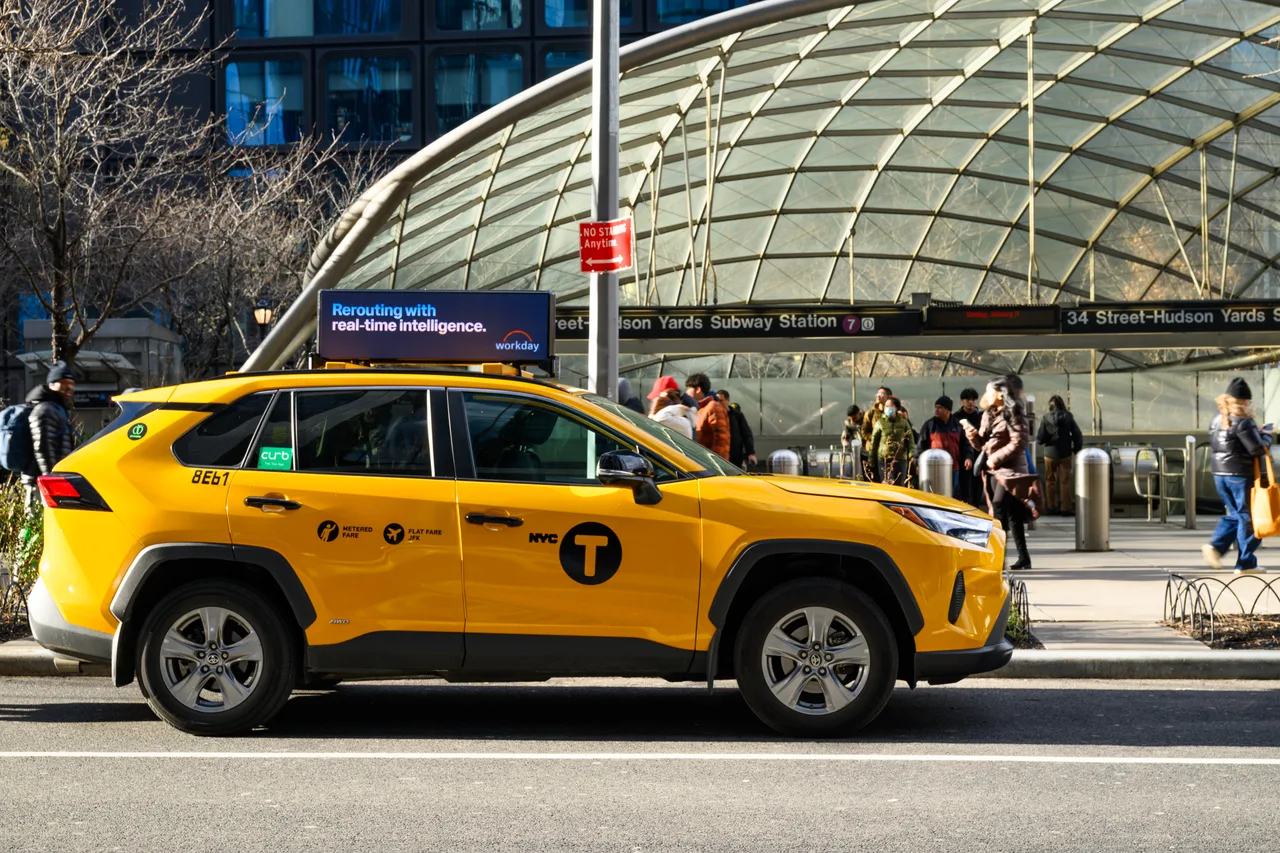
The 34 St-Hudson Yards entrance on the 7 line, January 2026, with a Workday digital taxi top passing it. The station is on OUTFRONT's station domination list. Campaign photograph from an operator's archive, used with permission.
Who Sells NYC Subway Advertising?
OUTFRONT Media, and only OUTFRONT Media. The MTA's own advertising page sends anyone who wants to buy space on subways, buses, stations or commuter rail to OUTFRONT, and anyone who wants a billboard on MTA property to Clear Channel Outdoor, with one named sales contact for each (MTA, Advertising and activations, retrieved 14 September 2026). There is no second subway vendor to play off against the first.
The contract is public because OUTFRONT is a listed company. Its annual report for 2025 lists Exhibit 10.1 as the "Advertising License Agreement, entered into December 8, 2017, to be effective as of November 1, 2017, by and between the Metropolitan Transportation Authority and Outfront Media Group LLC", and states: "In July 2021, we extended the initial 10-year term of the MTA Agreement to a 13-year base term (the 'Amended Term'). We have the option to extend the Amended Term for an additional five-year period at the end of the Amended Term, subject to satisfying certain quantitative and qualitative conditions" (OUTFRONT Media Inc., Form 10-K for the fiscal year ended 31 December 2025, read 14 September 2026). Thirteen years from November 2017 runs to late 2030; the option would carry it to 2035.
The same filing sets out what OUTFRONT owes the system: "5,433 digital advertising screens on subway and train platforms and entrances, 15,896 smaller-format digital advertising screens on rolling stock, and 9,283 MTA communications displays", title to which passes to the MTA on installation, plus "the greater of a percentage of revenues or a guaranteed minimum annual payment". OUTFRONT adds that its municipal contracts are "typically terminable for convenience at the option of the governmental entity (other than with respect to the MTA)". It is the one contract OUTFRONT cannot lose mid-term.
Two names a planner will meet are not the concessionaire. Intersection sells LinkNYC kiosks, PATH stations and the Amtrak areas of Penn Station, not the MTA subway (Intersection, New York, retrieved 14 September 2026). AdQuick and Blue Line Media are a marketplace and a reseller buying the same inventory through OUTFRONT. Whoever you buy from, the paper ends at OUTFRONT and the creative ends at the MTA.
What Can You Buy in the New York Subway?
Ten families of units, from a static poster above a station entrance to a screen network of more than 3,600 units, all listed in OUTFRONT's New York media kit, last revised 10 August 2026. The kit prints specifications and no prices. The table is read from it, and from the two-sheet OUTFRONT publishes for programmatic buyers where that gives more detail.
| Unit | Where it is | Specification as published | Unit of sale |
|---|---|---|---|
| Urban Panel (static) | Above subway entrances, Manhattan, Brooklyn, Queens, the Bronx | 30 in high by 60 in wide | Poster, four-week flight |
| Digital Urban Panel | Above subway entrances, beside train arrival times | 448 screens on the programmatic two-sheet; "450+" in the August 2026 kit. 1920 by 896 px, static creative only, no audio | 8-second spot in a 64-second loop, 8 advertisers, 24 hours |
| Video Urban Panel | Same positions, full motion | "450+" screens, 55 in and 65 in landscape; 1920 by 1080 px on the two-sheet | 5, 10 or 15-second spot in a 90-second loop, 8 advertisers |
| Liveboard Network | Platforms, mezzanines, corridors | 3,600+ screens in 340+ stations, 50 in and 65 in portrait, full motion, no audio | 5, 10 or 15-second spot in a 180-second loop, 10 advertisers, 2 spots reserved for the MTA |
| Livecard Network | Inside the car | 935 subway cars on the 2, 5, E, F, G, R, 4, 7, L, J, Z, M and A; 26.49 in portrait screens | 15-second spot in a 180-second loop, 10 advertisers, 2 reserved for the MTA |
| Interior cards | Above seats and doorways | 11 in by 46 in, 11 in by 70 in, 22 in by 21 in | Card packages, systemwide; Half Brand Train takes one side of a car |
| Platform posters | Station walls and pathways | 1-sheet and 2-sheet; the kit gives no dimensions | Systemwide, by borough or by station |
| Station Domination | 31 named stations, Times Sq-42 St to Flushing-Main St | "Media varies by station" | One advertiser, one station, every position |
| Faregates and stair risers | Turnstile area, staircases | By station or borough, non-domination stations only | Package |
| Brand Train, System Wrap, Wrapped Shuttle | Whole cars inside or out; the 42nd Street Shuttle | Not specified in the kit | Train or shuttle, by flight |
Specifications from the OUTFRONT New York media kit, last revised 10 August 2026, and the NYC Digital Urban Panel two-sheet, both retrieved 14 September 2026. Bus formats are sold under the same concession and are listed in the FAQ. Every digital unit carries preemption for emergency messaging.
The Screens Above the Entrance Are One Eighth of a Loop
A Digital Urban Panel sells an 8-second spot in a 64-second loop to 8 advertisers: your creative is on screen one eighth of the time. A Video Urban Panel is 5, 10 or 15 seconds in 90; a Liveboard is 5, 10 or 15 seconds in 180, with 10 advertisers and two slots kept by the MTA. When a deck says "450 screens", the arithmetic is 450 times one eighth, and then how many of those screens the flight actually includes.
The counts also differ between OUTFRONT documents. The programmatic two-sheet says 448 Digital Urban Panels; the August 2026 kit says "450+" in its specification box and "470+" in its body text. Ask for the live screen list with the proposal, not the brochure figure.
The Car Card Is Not 11 by 28 in New York
National rate cards describe the subway car card as 11 in by 28 in; AdQuick's format table lists the interior car card at 11 by 28 or 11 by 42 inches, and repeats those sizes in its New York section. That is an industry-standard size used in other cities, and it is worth checking before you build creative, because OUTFRONT's New York kit specifies three sizes and none of them is 28 inches wide: 11 in high by 46 in wide, 11 in high by 70 in wide, and a 22 in by 21 in square card at eye level. Build to OUTFRONT's template, not to a national kit, and confirm the size with OUTFRONT in writing before print.
How Much Does NYC Subway Advertising Cost?
OUTFRONT publishes no price for any MTA unit; its rates page says only that "OUTFRONT's rates are competitive and based on factors including the number of units and markets purchased, the coverage and duration of your campaign, time of year, and other market conditions" (outfront.com/resources/rates, retrieved 14 September 2026). Every figure in circulation is therefore a reseller's estimate. AdQuick's New York rows are $35 to $75 per interior car card, $1,500 to $3,000 per station poster and $3,000 to $10,000 per digital screen, each per four weeks; Blue Line Media's New York metro rows run from $50 for a horizontal interior display to $75,000 or more for a station domination (both retrieved 14 September 2026).
The ranges below are market-level figures compiled from publicly published vendor and industry sources. They are not quotes, and they are not the rates of any single network. Always get a written quote before budgeting.
| Publisher | Unit | Published range | Basis |
|---|---|---|---|
| AdQuick (marketplace), New York row | Interior car card | $35 to $75 per unit | per four weeks; "estimated ranges for standard placements" |
| AdQuick, New York row | Station poster | $1,500 to $3,000 | per four weeks |
| AdQuick, New York row | Digital screen | $3,000 to $10,000 | per four weeks |
| Blue Line Media (reseller), New York metro and New Jersey | Interior display, horizontal; vertical | $50 to $100; $75 to $150 | per display per four weeks, "estimated"; $5,000 minimum spend |
| Blue Line Media | 2 Sheet; Backlit Diorama | $400 to $950; $400 to $1,950 | per display per four weeks |
| Blue Line Media | Urban Panel | $750 to $2,000 | per display per four weeks |
| Blue Line Media | Station Domination | $25,000 to $75,000 or more | per station per four weeks |
| OUTFRONT Media (concessionaire) | Any MTA unit | No price published | quote only |
Three cautions. Blue Line's table covers the MTA, Metro-North, PATH and New Jersey Transit together, so its 2-sheet range is not an MTA-only figure, and the same site carries a notice that "certain info and images may be AI-generated". AdQuick states no method for its ranges. And neither publisher prices the Liveboard, Livecard or Video Urban Panel networks that make up most of what OUTFRONT has deployed since 2018. The only number that matters is the one on OUTFRONT's proposal, with the unit, the loop and the flight dates on it.
How Many People Ride the New York Subway?
1,281,883,362 rides in 2025, up 7.3% on 2024, with an average weekday of 4,001,735, which the MTA puts at 73% of 2019 (MTA, Subway and bus ridership for 2025, retrieved 14 September 2026). The busiest station was Times Sq-42 St at 61,203,303, followed by Grand Central-42 St at 35,764,931, 34 St-Herald Sq at 26,328,230 and 14 St-Union Sq at 24,316,583. Penn Station appears twice in the top ten because it is two subway stations, at 19,915,971 and 17,808,404.
Bus is smaller than the bus decks suggest. The MTA's narrative for 2025 puts bus ridership at 442 million, up 8.1%; its New York City Transit table on the same page shows 352,146,093, the difference being the buses the MTA Bus Company runs. Either way the subway carries roughly three rides for every bus ride.
Now the vendor figure. OUTFRONT's MTA page opens with "The MTA, with 2.6 billion rides yearly" (retrieved 14 September 2026). The MTA's own published totals for 2025 are 1,281,883,362 subway rides and 442 million bus rides, about 1.72 billion together. OUTFRONT does not say which year or which agencies its 2.6 billion covers; the MTA also runs Metro-North and the Long Island Rail Road, but the page does not show that arithmetic. Two sources, two numbers, a gap of roughly 0.9 billion. Use the MTA's page as the denominator for any subway CPM and ask the seller to reconcile its figure to it.
Screen counts wander the same way. OUTFRONT's MTA page says "14,800+ screens"; its New York market page says "50,000 digital screens deploying in the MTA subway system"; the 10-K obligation adds up to 30,612. Three documents, three counts, none of them the one on the proposal. Ask for that one.
Rides Are Not Impressions
A ride is a journey through a turnstile; the same commuter makes ten a week and passes the same Urban Panel twenty times. Geopath, the industry's measurement body, defines circulation as "a measurement of traffic volume in a market" that "only estimates the number of people with an opportunity to see" a display, and impressions as "the total number of times people passing an OOH display are likely to notice the ad" (Geopath glossary, retrieved 14 September 2026). A CPM built on rides is a circulation CPM. Ask which one you are being shown, and note that AdQuick's page still says "roughly 3.6 million weekday subway trips" against the MTA's 4,001,735 for 2025.
What Does the MTA Allow on Its Screens?
Commercial advertising, certain public service announcements and government messages, and nothing political. The MTA Advertising Policy in force is effective 25 June 2025, and it states that "the MTA expressly intends that the advertising space on the Property be a non-public forum" (MTA Advertising Policy, PDF, read 14 September 2026). That phrase is the legal basis for refusing an ad, and it is why creative that runs on a billboard across the street can be turned away at the turnstile.
The prohibited list is long and specific: anything that "promotes or opposes a political party, a ballot referendum, any proposed or contemplated legislation or regulation, or the election of any candidate", anything that "prominently or predominantly supports, opposes, or comments on" government action or "a matter of public policy", tobacco, nicotine, cannabis and hallucinogenic mushroom products, profanity, sexually oriented products and services, and material that "demeans, disparages, praises, or promotes" a group on the basis of race, religion, sexual orientation and the other listed classes. Alcohol is prohibited by default, with carve-outs in section IV.D.
The carve-outs decide where a drinks brand can appear at all. Digital formats inside stations, cars and buses, or on station exteriors, may carry alcohol only outside "6 a.m. to 8 a.m. and 2 p.m. to 5 p.m. on weekdays when school is in session", may not be "targeted to run in any particular geographic community", and exterior signs must be certified not readable within 500 feet of a school, playground or place of worship. A fixed train wrap is allowed only on the S shuttle. Fixed formats are allowed in "the commuter rail portions of Grand Central Terminal, Grand Central Madison, Jamaica Station and Penn Station", or in stations adjacent to venues where alcohol is served and "the venue's seating capacity is 5,000 or more (if within New York City) or 1,500 or more" elsewhere in the MTA area. Billboards need the 500-foot certification.
Who decides is also set out: "The advertising contractor has no authority to reject an advertisement on behalf of the MTA and any statements by the advertising contractor to the advertiser regarding an advertisement are not binding on the MTA." OUTFRONT screens the creative and refers doubtful cases to the MTA's Advertising Review Committee, which may look at the advertiser's website and the content behind a QR code before deciding. Build the review time into the flight.
How Do You Buy NYC Subway Advertising?
Through OUTFRONT, directly or through an agency or marketplace, with the MTA's advertiser request form filed before anything runs. OUTFRONT's subway page states that "the standard length of a subway advertising campaign is four weeks". This sequence keeps the proposal comparable to anything else on the plan.
- Pick the unit family first, then the stations. The domination list in the kit names 31 stations, from 116 St to Times Sq-42 St/Port Authority Bus Terminal; if your station is not on it, the buy is a package of positions, not a takeover.
- Get the loop and the screen list in writing. Spot length, loop length, advertisers per loop, the two MTA-reserved slots, and the units by station and entrance. "450 screens" without a loop is not a specification.
- Build to OUTFRONT's New York specs. 1920 by 896 pixels for a Digital Urban Panel, 1920 by 1080 for a Video Urban Panel, 11 by 46 or 11 by 70 inches for interior cards, no audio anywhere.
- Clear the policy before you clear production. Alcohol, anything that reads as public policy, and QR codes that lead to either, go to the Advertising Review Committee.
- Agree the audience source. MTA rides, Geopath impressions or a modelled figure, with the year, on the proposal.
What the subway does not do is move. The screens above the entrance to Times Sq-42 St face the same block all day; the moving formats through that block are specified on the New York taxi advertising page. The spectaculars above the same station are on the Times Square billboard guide, and the highway and elevated-line billboards that Clear Channel sells on MTA property are on the NYC billboard page. Where the subway sits against all of them, format by format, is the advertising in New York City decision table, and the regulator column for every format is on the home page.
Frequently Asked Questions
How much does it cost to advertise on the MTA?
OUTFRONT Media, the only company that sells MTA advertising, publishes no rates. The published third-party ranges for New York are AdQuick's $35 to $75 per interior car card, $1,500 to $3,000 per station poster and $3,000 to $10,000 per digital screen, all per four weeks, and Blue Line Media's $400 to $950 for a 2-sheet and $25,000 to $75,000 or more for a station domination. None is a quote.
Who sells advertising on the NYC subway?
OUTFRONT Media, under an Advertising License Agreement with the MTA effective 1 November 2017, extended in July 2021 to a 13-year base term with a five-year option. The MTA's own advertising page sends subway, bus and commuter rail buyers to OUTFRONT and billboard buyers to Clear Channel Outdoor. Marketplaces such as AdQuick and resellers such as Blue Line Media buy the same inventory through OUTFRONT.
How can I advertise on trains in New York?
Inside the car, OUTFRONT's New York media kit lists interior cards at 11 by 46 inches, 11 by 70 inches and 22 by 21 inches, a Half Brand Train that takes one side of a car, full Brand Trains, and the Livecard Network of 26.49-inch screens in 935 subway cars on 13 lines. Every submission goes through OUTFRONT and the MTA's advertising policy; commuter rail cars are a separate buy on Metro-North and the Long Island Rail Road.
How much does it cost to put your ad on a bus in NYC?
MTA bus exteriors and interiors are sold by OUTFRONT under the same concession as the subway, and OUTFRONT publishes no rate. The formats in its New York kit are Ultra Super Kings, Kings, Super King Posters, 30x215s, Kongs, Tails, Queens, full wraps and interior bus cards. Blue Line Media's national transit rate card lists bus ads at $500 to $900 for traditional sizes and $1,500 to $12,500 for larger units per display per four weeks; those are national ranges, not New York quotes.
How many people see an ad in the New York subway?
The MTA counted 1,281,883,362 subway rides in 2025, an average weekday of 4,001,735, with Times Sq-42 St the busiest station at 61,203,303. Those are rides, not people and not impressions. Geopath, the industry measurement body, defines circulation as traffic passing a display and impressions as the number of times people are likely to notice the ad. Ask the seller which of the two a CPM is built on.
Can you advertise alcohol on the NYC subway?
Only inside the exceptions in section IV.D of the MTA Advertising Policy effective 25 June 2025: digital formats inside stations, cars and buses or on station exteriors, run outside 6 to 8 a.m. and 2 to 5 p.m. on school weekdays and not geo-targeted; a train wrap on the S shuttle only; fixed formats in the commuter rail portions of Grand Central, Grand Central Madison, Jamaica and Penn Station, or in stations next to venues seating 5,000 or more in the city; and billboards certified not readable within 500 feet of a school, playground or place of worship.
The Bottom Line
New York subway advertising is a single-vendor market with a public contract, a public policy, a public rider count and a private price. Use the 10-K to know who you are dealing with and for how long, the MTA's 2025 ridership page as the denominator for every CPM, OUTFRONT's own kit for sizes and loop lengths, and the June 2025 policy to know what will be refused before you shoot it. Nothing on this page is a quote; the quote comes from OUTFRONT, with the screen list on it.
What to send us
- The market, or the boroughs
- The dates, or the flight length
- The budget band
- The metric you will judge it by
A person replies with the sellers and formats that fit and the published ranges for them. No rate card exists on this site; every figure here is a third-party published number.
Send the brief
Sources
- OUTFRONT Media Inc., Annual Report on Form 10-K for the fiscal year ended December 31, 2025 (MTA Agreement: effective date, 13-year Amended Term, five-year option, deployment obligations, payment terms; Exhibit 10.1) · sec.gov · read 14 September 2026
- MTA, Advertising and activations (OUTFRONT for subway, bus, stations and commuter rail; Clear Channel Outdoor for billboards) · mta.info · retrieved 14 September 2026
- MTA Advertising Policy (effective 25 June 2025; non-public forum; prohibited categories; section IV.D alcohol exceptions; review procedure) · mta.info/document/65096 (PDF) · read 14 September 2026
- MTA, Subway and bus ridership for 2025 (1,281,883,362 annual, 4,001,735 weekday, station table, bus totals) · mta.info · retrieved 14 September 2026
- OUTFRONT Media, New York media kit (last revised 10 August 2026; interior card sizes, Livecard, Liveboard, Urban Panel, Station Domination and bus specifications) · PDF via outfront.com/markets/new-york-city · retrieved 14 September 2026
- OUTFRONT Media, NYC Digital Urban Panels and Video Urban Panels two-sheet (448 screens, pixel sizes, spot and loop lengths, DSP availability, MTA advertiser request form) · PDF · retrieved 14 September 2026
- OUTFRONT Media, MTA Advertising Network ("2.6 billion rides yearly", "14,800+ screens", 94% weekly reach; no rates) · outfront.com/mta · retrieved 14 September 2026
- OUTFRONT Media, New York City Billboards & Subway Advertising ("50,000 digital screens deploying", 99% weekly reach citing Geopath 2019) · outfront.com/markets/new-york-city · retrieved 14 September 2026
- OUTFRONT Media, Subway Advertising (four-week standard flight; formats) · outfront.com · retrieved 14 September 2026
- OUTFRONT Media, Rates (no figures published; rates "based on factors including the number of units and markets purchased") · outfront.com/resources/rates · retrieved 14 September 2026
- AdQuick, Subway Advertising: Costs, Formats & Markets (New York ranges, national format table, 11 by 28 car card, "estimated ranges", 3.6 million weekday figure) · adquick.com/subway-advertising · retrieved 14 September 2026
- Blue Line Media, New York City Metro Area Subway-Train Advertising (rate table, $5,000 minimum, market scope, AI-generated content notice) · bluelinemedia.com · retrieved 14 September 2026
- Blue Line Media, Transit Advertising (national bus ranges) · bluelinemedia.com/transit-advertising · retrieved 14 September 2026
- Intersection, New York (LinkNYC, PATH and Penn Station Amtrak inventory; not the MTA subway) · intersection.com · retrieved 14 September 2026
- Geopath, Glossary (circulation, impressions, CPM definitions) · geopath.org/glossary · retrieved 14 September 2026