Advertising in New York City means choosing among seven out-of-home formats: Times Square spectaculars, billboards and wallscapes, MTA subway and bus, taxi tops, street furniture, LinkNYC kiosks and vehicle wraps. Each is sold by different companies, counted a different way and governed by a different agency. New York was the largest local OOH market in 2025 at $858 million (OAAA).
The mistake out-of-town planners make is treating New York as one market with one rate card. It is five markets that happen to share a skyline. The MTA writes its own advertising policy and sells through a single concessionaire; the Taxi and Limousine Commission governs what sits on a cab; the Department of Buildings and the Zoning Resolution decide where a billboard may stand; the Department of Transportation owns the sidewalk furniture and the traffic rules that ban advertising trucks; the Office of Technology and Innovation holds the kiosk franchise. The table below puts all seven formats side by side. Each row links to the deeper guide on this site.
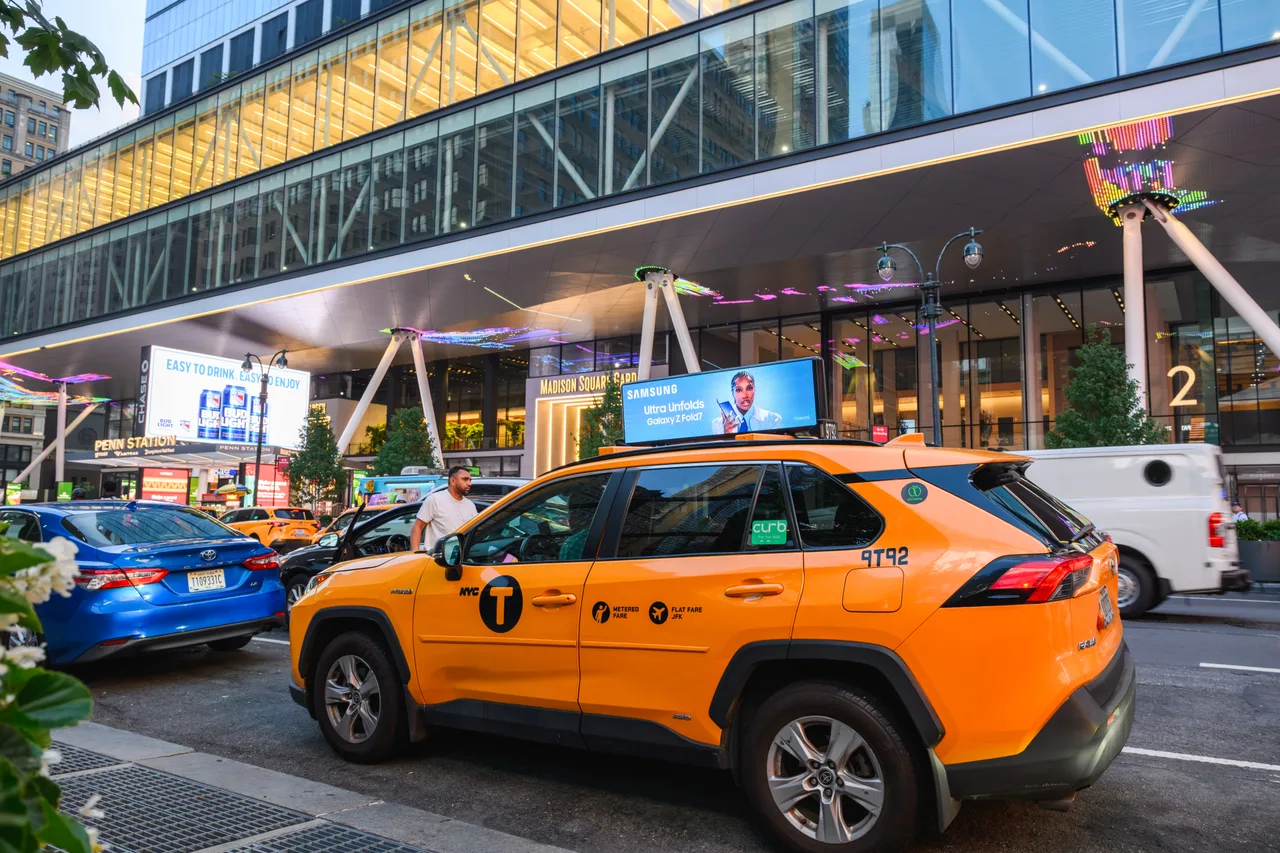
Three formats in one frame at the Penn District, July 2025: a digital taxi top, a digital billboard on the Madison Square Garden facade, and the Penn Station entrance whose interior screens belong to the MTA concession. Campaign photograph from an operator's archive, used with permission.
Which Out-of-Home Formats Can You Buy in New York City?
Seven, if you count by who sells them and who regulates them rather than by what they look like. The table is the page; the sections after it explain the two columns that matter most, the regulator and the counting method. Sellers are listed as published on their own New York pages, retrieved 14 September 2026, and no seller on this page is quoted a price.
| Format | Where it works | Who sells it | How it is counted | Who regulates it | Typical buy unit | Where it loses |
|---|---|---|---|---|---|---|
| Times Square spectaculars | The Bowtie, 40th to 53rd Street; launches, entertainment, moments built for social reach | Fifteen companies on the Times Square Alliance's screens page, led by OUTFRONT Media, Clear Channel Outdoor, Silvercast, Branded Cities and New Tradition | Times Square Alliance camera counts, 200,000 to 250,000 pedestrians a day; vendors cite higher | Department of Buildings; Zoning Resolution 81-732 requires the signs | Share of a loop per flight; static units per four-week cycle, production extra | Reach beyond the district; price opacity; static installation can cost more than media |
| Billboards and wallscapes | Expressways in Queens, Brooklyn and the Bronx; bridge and tunnel approaches; walls in Lower Manhattan and Brooklyn | Clear Channel Outdoor, OUTFRONT Media, Lamar, Branded Cities; Clear Channel for billboards on MTA property | Geopath impressions per face | Department of Buildings permits and OAC register; Zoning Resolution 32-63, 32-662, 42-65 | Four-week cycle; digital as an 8-second spot in a 64-second loop | Scarce in Manhattan; no new signs within 200 feet of an arterial highway |
| Subway and bus (MTA) | 472 stations, 1,281,883,362 rides in 2025; commuters, systemwide or by station | OUTFRONT Media only; resold through AdQuick, Blue Line Media and agencies | MTA ridership plus Geopath; screen loops logged | MTA Advertising Policy, effective 25 June 2025, a non-public forum | Urban Panel 8 seconds in 64; Liveboard 5, 10 or 15 seconds in 180; cards and posters per four weeks | No political or public-policy creative; alcohol only inside narrow carve-outs; fixed to stations |
| Taxi tops, digital and static | Yellow and green cabs across the five boroughs; moving through Midtown all day | NY Taxi Ads, Blue Line Media, Firefly and other networks | Digital tops log each play with GPS; static tops modelled from mileage | Taxi and Limousine Commission, exempted by name in Traffic Rules 4-12(j)(1) | Per top per four weeks; digital by daypart and neighbourhood | Cannot hold one intersection at 100% share of voice; small canvas |
| Street furniture | Sidewalks citywide, over 3,300 bus shelters plus newsstands | JCDecaux under the NYC DOT Coordinated Street Furniture Franchise | Geopath impressions per panel | Department of Transportation franchise, advertising "within clearly defined limits" | Per panel per four weeks, block by block | Eye-level poster scale; one panel holds one block |
| LinkNYC kiosks | Sidewalk kiosks in all five boroughs; "over 3,750 digital screens" | Intersection | Each screen logs its plays; programmatic via DSPs | Office of Technology and Innovation, Public Communications Structure Franchise with CityBridge, LLC | Group of kiosks by neighbourhood and daypart | Sidewalk kiosk scale; sold as a network, not a single site |
| Vehicle wraps and mobile billboards | Fleets that already drive for a living; trucks are effectively barred | Wrap networks and fleet owners; no legal ad-truck market in the city | Modelled from routes driven | NYC Traffic Rules 4-12(j)(1) and 4-08(n)(3), Department of Transportation | Per vehicle per flight | A vehicle operated, stood or parked "for the purpose of commercial advertising" is prohibited |
The seller lists are deliberately short and deliberately not ranked. Where a format has one seller, it is because a franchise or concession makes it so, and that is the single most useful thing to know before you ask for a proposal.
Who Regulates Advertising in New York City?
Five bodies, and which one applies depends on the surface, not the advertiser. Their rules are public and they are where most New York surprises come from.
The MTA. Its Advertising Policy, effective 25 June 2025, states that "the MTA expressly intends that the advertising space on the Property be a non-public forum", bars advertising that "promotes or opposes a political party, a ballot referendum, any proposed or contemplated legislation or regulation, or the election of any candidate", and prohibits alcohol except inside the carve-outs in its section IV.D (MTA Advertising Policy, PDF, read 14 September 2026). The MTA's advertising page sends all subway, bus and commuter rail buyers to OUTFRONT Media and billboard buyers to Clear Channel Outdoor (MTA, Advertising and activations). OUTFRONT's concession, effective 1 November 2017 and extended to a 13-year base term, is set out in its 2025 annual report (OUTFRONT Media, Form 10-K).
The Department of Transportation. Two things. It holds the Coordinated Street Furniture Franchise, awarded to Cemusa in 2005 and now held by JCDecaux under a restated agreement, covering "over 3,300 bus shelters", up to 40 automatic public toilets and the city's newsstands, with the franchisee allowed "to sell advertising space on the structures within clearly defined limits" (NYC DOT, Coordinated Street Furniture). And it writes the Traffic Rules. Section 4-12(j)(1): "No person shall operate, stand, or park a vehicle or bicycle on any street or roadway for the purpose of commercial advertising." A business may put notices about its own business on a vehicle in normal use, "provided that no portion of any such notice shall be reflectorized, illuminated, or animated, and provided that no such notice shall be put upon the top of the vehicle". Section 4-08(n)(3) repeats the standing and parking ban and points back to the same definition (34 RCNY 4-08 and 34 RCNY 4-12, Rules of the City of New York, read 14 September 2026). The exemptions are in the same paragraph: "Advertisements may be put upon vehicles licensed by the New York City Taxi and Limousine Commission in accordance with the Commission's rules", and buses under a DOT franchise and Sanitation vehicles may carry commercial advertising. That is why the taxi top exists and the advertising truck does not.
The Department of Buildings and the Zoning Resolution. An advertising sign "directs attention to goods or services at a location other than the premises where the sign is located" (NYC Buildings, Sign). It needs a permit, an operator registered as an Outdoor Advertising Company, and a zoning district that allows it: C6-5, C6-7 and C8 in commercial districts, M1 to M3 in manufacturing districts, and nowhere within 200 feet of an arterial highway or a park of half an acre or more if the sign is within view of it (Zoning Resolution 32-662, last amended 6 June 2024). Times Square inverts the rule: Section 81-732 requires illuminated signs there.
The Taxi and Limousine Commission. Governs what may be carried on a licensed taxi or for-hire vehicle, the exemption the Traffic Rules refer to by name. The formats, the rules and the counting are on the New York taxi advertising page.
The Office of Technology and Innovation. Holds the Public Communications Structure Franchise with CityBridge, LLC, first approved by the Franchise and Concession Review Committee in 2014 and amended in 2015, 2018 and 2021, under which the LinkNYC kiosks stand on the city's right-of-way (NYC OTI, LinkNYC Franchises, retrieved 14 September 2026). Intersection sells the screens, "over 3,750 digital screens, spanning 3,250 blocks of the city in all 5 boroughs" by its own count (Intersection, New York).
How Is Out-of-Home Advertising Counted in New York?
Four different ways, which is why two formats quoting the same CPM are not comparable until you know the denominator. Times Square is counted by camera: the Times Square Alliance publishes 200,000 to 250,000 pedestrians a day, and the vendor figures that run up to 360,000 are examined on the Times Square page. The subway is counted by turnstile: the MTA recorded 1,281,883,362 rides in 2025 and an average weekday of 4,001,735 (MTA, Subway and bus ridership for 2025), and rides are journeys, not people. Billboards and shelters are counted by Geopath, which defines circulation as traffic passing a display and impressions as "the total number of times people passing an OOH display are likely to notice the ad" (Geopath glossary, retrieved 14 September 2026). Digital taxi tops and LinkNYC screens log their own plays, with a GPS position for each on the taxi.
The practical rule: a logged play is a count, a Geopath impression is a model of who noticed, a ride is a journey and a camera count is a body. Ask every seller which of the four sits under its CPM, and for which year. The home page's format matrix carries the counting column for every row above.
How Much Does Advertising in New York City Cost?
The owners of most New York inventory publish no rates, so the figures below are the reseller and marketplace ranges that the deeper pages on this site examine line by line. They are here for orientation only.
The ranges below are market-level figures compiled from publicly published vendor and industry sources. They are not quotes, and they are not the rates of any single network. Always get a written quote before budgeting.
| Format | Published range | Publisher and basis |
|---|---|---|
| Times Square spectacular | $30,000 to $100,000+ per four-week cycle; $50,000 per four weeks for a 15-second spot on a standard screen | AdQuick; PJX Media. Screen owners publish nothing. See the Times Square page |
| Billboards | $2,000 to $5,000 static poster; $5,500 to $24,000 static bulletin; $7,000 to $24,000 digital bulletin; $20,000 to $150,000 wallscape, per four weeks | Blue Line Media, New York City page, "est.", $5,000 minimum |
| Subway | $35 to $75 per car card; $1,500 to $3,000 per station poster; $3,000 to $10,000 per digital screen, per four weeks; station domination $25,000 to $75,000 or more | AdQuick New York rows; Blue Line Media. OUTFRONT publishes nothing |
| Taxi top | $200 to $500 static; $400 to $600 digital, per display per four weeks | Blue Line Media national taxi rate card, "estimated" |
| Bus shelter | $600 to $900 in small to medium markets; $3,000 to $6,500 "for high-income areas", per display per four weeks | Blue Line Media national transit rate card; JCDecaux publishes nothing |
| LinkNYC kiosk | No range published | Intersection, quote only |
Every row above was read from the publisher's live page on 14 September 2026 (AdQuick, Blue Line Media New York billboards, Blue Line Media taxi, Blue Line Media transit). None states a method, and the Blue Line site carries a notice that some of its content may be AI-generated. Where a figure is national rather than New York, the table says so.
Do You Need an Agency to Buy OOH in New York?
No. Every owner in the table sells direct. The MTA's advertising page publishes a named OUTFRONT sales contact; Clear Channel, Lamar and OUTFRONT run New York sales offices; JCDecaux and Intersection take direct enquiries; the taxi networks sell direct. A planner with one format and one owner in mind can buy it without an intermediary, and the proposal will be the same document either way.
What an agency or a marketplace adds is the work between the owners: a plan that spans five regulators and four counting methods, negotiation across sellers who do not compete on the same surface, production management for units with different specifications, and measurement that can be read across formats. Marketplaces such as AdQuick aggregate the inventory and print planning ranges; agencies such as PJX Media buy Times Square for clients and publish what they see. Neither replaces the owner's quote. If the plan is one Liveboard flight, buy it direct. If it is a launch across the Bowtie, the subway entrances beneath it and the cabs passing through, the fee buys someone whose job is to make the four audience numbers reconcile.
Frequently Asked Questions
How much does it cost to advertise in NYC?
It depends on the format, and the owners of most New York out-of-home inventory publish no rates. The published third-party ranges, per four weeks unless stated, run from $200 to $500 for a static taxi top and $2,000 to $5,000 for a static poster billboard, through $3,000 to $10,000 for a subway digital screen and $7,000 to $24,000 for a digital bulletin, to $20,000 to $150,000 for a wallscape and $30,000 to $100,000 or more for a Times Square spectacular. None is a quote.
How much is a 30 second ad in Times Square?
No publisher prints a 30-second Times Square rate. The screens sell a share of a loop for a flight: PJX Media quotes $50,000 per four weeks for a 15-second spot on a standard screen, and AdQuick $10,000 to $22,000 for two weeks on a shared digital slot. The screen owners publish nothing. The full breakdown, with the pedestrian count under each CPM, is on this site's Times Square page.
What exactly is OOH advertising?
Out-of-home advertising is media seen outside the home: billboards, street furniture such as bus shelters and kiosks, transit such as subway, bus and taxi, and place-based screens. The Out of Home Advertising Association of America reports the four categories separately and puts 2025 United States OOH spend at $9.46 billion, up 3.6%. In New York the same four categories are sold by different companies under different regulators.
Can you advertise on a truck in New York City?
Not as a stand-alone advertising vehicle. New York City Traffic Rules section 4-12(j)(1) states that no person shall operate, stand or park a vehicle on any street for the purpose of commercial advertising, and section 4-08(n)(3) repeats the standing and parking ban. A business may carry notices about its own business on a working vehicle, but not on the roof, not illuminated and not animated. Vehicles licensed by the Taxi and Limousine Commission and franchised buses are exempt.
Who regulates advertising in New York City?
Five bodies, one per surface. The MTA writes the advertising policy for subways, buses and commuter rail and sells through OUTFRONT Media. The Taxi and Limousine Commission governs taxi and for-hire vehicle advertising. The Department of Buildings permits and registers billboards, within limits set by the Zoning Resolution. The Department of Transportation holds the street furniture franchise with JCDecaux and writes the traffic rules on advertising vehicles. The Office of Technology and Innovation holds the LinkNYC franchise with CityBridge.
Do you need an agency to advertise in New York?
No. OUTFRONT, Clear Channel Outdoor, Lamar, JCDecaux, Intersection and the taxi networks all sell direct, and the MTA's own advertising page publishes a named OUTFRONT contact. An agency or a marketplace adds cross-owner planning, negotiation, production management and measurement. For a single-format buy from one owner it is optional; for a plan that spans five regulators and four counting methods it earns its fee.
Is OOH advertising still relevant?
The trade body's figures say it is growing. OAAA reports 2025 United States out-of-home spend of $9.46 billion, up 3.6% on 2024, with transit up 9.8% and street furniture up 5.6%. In the New York DMA, OAAA's MediaRadar-based table puts 2025 local out-of-home spend at $858,054,320, 25.8% of all local ad spend and the highest share of any market, with OAAA's own note that MediaRadar under-reports OOH by roughly 30%.
The Bottom Line
Advertising in New York City is not one decision but seven, each with its own seller, its own regulator and its own way of counting a person. Use the table to find which format fits the campaign, the regulator section to know what will be refused before it is designed, and the counting section to make the CPMs comparable before anything is compared. Then go to the deeper page for the format, where every figure carries its source and date, and get the quote from the owner, with the unit on it.
What to send us
- The market, or the boroughs
- The dates, or the flight length
- The budget band
- The metric you will judge it by
A person replies with the sellers and formats that fit and the published ranges for them. No rate card exists on this site; every figure here is a third-party published number.
Send the brief
Sources
- OAAA, 2025 OOH Ad Spend Performance, Facts and Figures (2025 US OOH spend $9.46 billion, +3.6%; category growth; New York DMA $858,054,320 local OOH spend, 25.8% share, rank 1; MediaRadar under-reporting note) · oaaa.org (PDF) · retrieved 14 September 2026
- MTA Advertising Policy (effective 25 June 2025; non-public forum; prohibited categories; alcohol carve-outs) · mta.info/document/65096 (PDF) · read 14 September 2026
- MTA, Advertising and activations (OUTFRONT for transit, Clear Channel Outdoor for billboards) · mta.info · retrieved 14 September 2026
- MTA, Subway and bus ridership for 2025 (1,281,883,362 rides; 4,001,735 weekday) · mta.info · retrieved 14 September 2026
- OUTFRONT Media Inc., Form 10-K for the fiscal year ended December 31, 2025 (MTA Agreement effective 1 November 2017, 13-year Amended Term, five-year option) · sec.gov · read 14 September 2026
- Rules of the City of New York, Title 34, Section 4-08 Parking, Stopping, Standing (subdivision (n)(3), parking for commercial advertising prohibited) · codelibrary.amlegal.com · read 14 September 2026
- Rules of the City of New York, Title 34, Section 4-12 Miscellaneous (subdivision (j), commercial advertising vehicles; TLC, franchised bus and Sanitation exemptions) · codelibrary.amlegal.com · read 14 September 2026
- NYC DOT, Coordinated Street Furniture (Cemusa award, JCDecaux, over 3,300 bus shelters, advertising rights) · nyc.gov/dot · retrieved 14 September 2026
- NYC Buildings, Sign (advertising sign definition; permits; Outdoor Advertising Registration Program) · nyc.gov/buildings · retrieved 14 September 2026
- New York City Zoning Resolution, Sections 32-63, 32-662 and 42-65 (districts permitting advertising signs; 200-foot arterial and park rule; last amended 6 June 2024) · zr.planning.nyc.gov · read 14 September 2026
- NYC Office of Technology and Innovation, LinkNYC Franchises (Public Communications Structure Franchise with CityBridge, LLC; 2014 approval and amendments) · nyc.gov/oti · retrieved 14 September 2026
- Intersection, New York (LinkNYC screen count; PATH and Penn Station inventory) · intersection.com · retrieved 14 September 2026
- OUTFRONT Media, New York City Transit & Subway Advertising Guide, Meet the MTA, Part 1 (472 stations) · outfront.com · retrieved 14 September 2026
- Times Square Alliance, Market Research & Data (200,000 to 250,000 pedestrians a day) · timessquarenyc.org · retrieved 14 September 2026
- Geopath, Glossary (circulation and impressions definitions) · geopath.org/glossary · retrieved 14 September 2026
- AdQuick, How Much Does a Billboard Cost? 2026 Prices & CPM and Subway Advertising (Times Square and New York ranges) · adquick.com/billboard-cost, adquick.com/subway-advertising · retrieved 14 September 2026
- PJX Media, Cost of Billboard Advertising in Times Square ($50,000 per four weeks, 15-second spot) · pjxmedia.com · retrieved 14 September 2026
- Blue Line Media, New York City Billboard Advertising; Taxi Advertising; Transit Advertising (rate tables, $5,000 minimum, AI-generated content notice) · bluelinemedia.com · retrieved 14 September 2026