A Times Square billboard is quoted at $50,000 per four weeks for one 15-second spot on a standard screen (PJX Media); a digital taxi top scheduled through the same district is listed at $400 to $600 per display per four weeks (Blue Line Media). One holds the Bowtie; the other moves through it. Neither figure is a quote.
That gap, roughly a hundred to one on the media line alone, is why "Times Square billboard vs taxi advertising" is a search that media planners run and screen owners never answer. The two formats are not substitutes. A spectacular is bought for one intersection at height; a taxi top is bought for the streets that feed it. This page puts them in one table with the third option most plans forget, OUTFRONT Media's digital panels at the Times Sq-42 St entrances, and says plainly which is the right buy for which brief. The spectacular figures are the ones examined line by line on the Times Square billboard guide; the taxi figures are the third-party ranges used across this site; nothing here is any operator's rate, in line with the standard every page on this site applies.
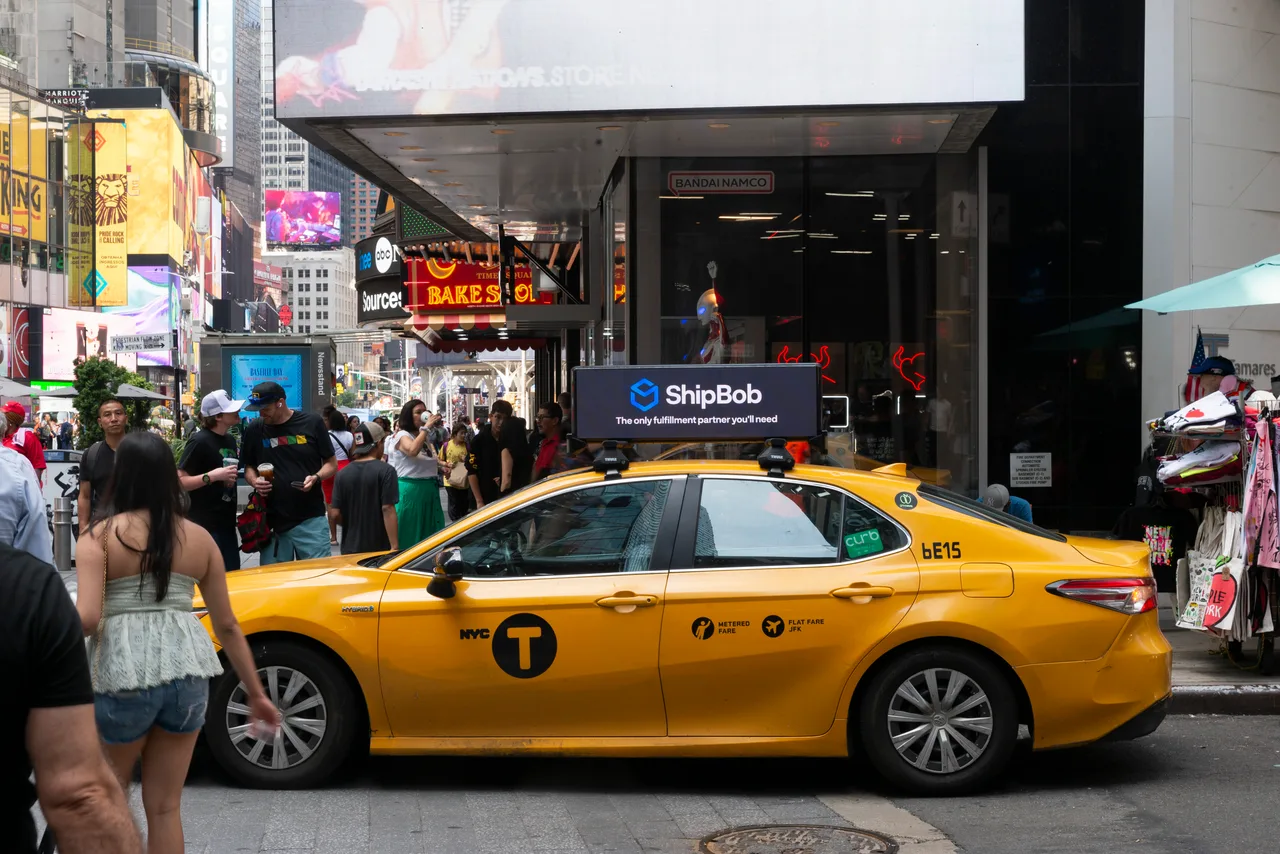
ShipBob on a digital taxi top in Times Square, 2024, with the Marriott Marquis sign and The Lion King poster behind it. The Marriott Marquis is the building whose screen PJX Media prices at $300,000 per four weeks for a standard spot. Campaign photograph from an operator's archive, used with permission.
Times Square Billboard vs Taxi Tops vs MTA Panels: The Comparison
Three formats, ten criteria. The spectacular column is the digital or static face on a building around the Bowtie. The taxi column is a digital roof screen whose plays are scheduled by neighbourhood, time of day and day of week, so a flight can be weighted to the district; no one routes a yellow cab, the cab follows its fares and the schedule decides what plays when the GPS says it is inside the zone. The panel column is the OUTFRONT Media Digital Urban Panel above the subway entrances, sold under the MTA concession.
The ranges below are market-level figures compiled from publicly published vendor and industry sources. They are not quotes, and they are not the rates of any single network. Always get a written quote before budgeting.
| Criterion | Times Square spectacular | Digital taxi tops, scheduled through Times Square | MTA Digital Urban Panels at Times Sq-42 St |
|---|---|---|---|
| Who sells it | Fifteen companies on the Times Square Alliance's screens page, led by OUTFRONT Media, Clear Channel Outdoor, Silvercast, Branded Cities and New Tradition; agencies and marketplaces such as PJX Media and AdQuick buy the same screens | Firefly (GPS-enabled full-motion digital tops with time-of-day and day-of-week scheduling, static tops, and 360, 270 and 180-degree wraps, per its on-car page); SOMO; NY Taxi Ads; resellers such as Blue Line Media | OUTFRONT Media, the MTA's concessionaire for stations, trains and buses; resold through marketplaces and available through DSPs |
| Unit and flight | One face. Digital: a share of the loop, stated as spot length in loop length or as minutes per hour, per four weeks. Static: the face, per four-week cycle | Per display, meaning one two-sided roof unit, per four weeks; the buy is a number of tops and a schedule of plays weighted to the district | An 8-second spot in a 64-second loop, per panel, per four weeks; the panels around the 42nd Street complex are sold as a group of entrances, not one unit |
| Published price ranges (third-party only) | AdQuick: $10,000 to $22,000 per two weeks on a shared digital slot; $30,000 to $100,000+ per four-week cycle for a premium spectacular. PJX Media: $50,000 per four weeks for one 15-second spot on a standard screen; $300,000 on the Marriott Marquis; $10,000 to $500,000 by minutes per hour. Screen owners: no price published | Blue Line Media, New York page: $400 to $600 per digital top per display per four weeks, $5,000 minimum per format. AdQuick, national: $120 to $800 per vehicle per four weeks, New York at the upper end. The operator named first in this column publishes no rate: on request | No panel price published. The nearest published figure is AdQuick's New York subway row, $3,000 to $10,000 per digital screen per four weeks, which is a station screen, not a street panel |
| Audience, and how it is counted | Times Square Alliance camera counts: 200,000 to 250,000 pedestrians a day, roughly 220,000 on average in 2024, peaks to 330,000. Vendor pages cite up to 360,000 | Geopath, which lists taxi panels under transit displays, defines an impression as the number of times people passing a display are likely to notice the ad; a digital top adds a GPS log per play. The denominator is 8,878 yellow taxis on the road a day, 8.5 hours each (TLC, May 2026) | MTA ridership: 61,203,303 riders at Times Sq-42 St in 2025, the busiest station in the system; OUTFRONT cites Geopath for its transit audience |
| Share of voice | A share of one loop on one face: AdQuick describes an 8-to-10-second spot in a 60-to-90-second loop; PJX sells minutes per hour, with a roadblock, 100% of a screen, in blocks of at least an hour. Among the 40-plus displays Clear Channel Outdoor alone counts | One advertiser on the screen per play; a digital top rotates advertisers, but no second screen competes on the same roof. A static top is 100% of that cab for the flight | One eighth of the loop on each panel: 8 seconds in 64 |
| Creative flexibility | Static: printed once for the cycle. Digital: video to the screen's specification, changed through the seller; 3D anamorphic work is its own budget line (PJX) | Full-motion or static creative with HTML dynamic content, scheduled by neighbourhood, time of day and day of week over GPS (Firefly, on-car page); AdQuick says creative on a digital top can be swapped in hours rather than weeks | Static creative only, no audio, 1920 by 896 pixels, 8 seconds (OUTFRONT two-sheet, 2025) |
| Production and installation | Static: PJX puts production at $20,000 to $30,000 and installation at $80,000 to $100,000, both one-time. Digital: no print; creative to spec | Digital top: a file to spec, no print, no install. Static top: a printed panel. Wraps: AdQuick states its wrap pricing includes printing, lamination and installation | None. A static file to the panel's resolution |
| Regulation | Zoning Resolution 81-732 requires illuminated signs on the frontages it covers and sets their minimum area and brightness; the Department of Buildings permits them | TLC rule 35 RCNY 67-16: a medallion owner who pays the annual advertising permit fee may install a rooftop fixture authorised by the TLC, tested to MIL-STD 810f and approved by its Safety and Emissions Division. Rooftop advertising is not approved on for-hire vehicles (59A-29(e)(2)), so in New York the format runs on yellow medallion taxis and green street-hail liveries, not on Uber or Lyft cars | MTA advertising policy; every buy goes through the MTA advertiser request form and carries preemption for emergency messaging (OUTFRONT two-sheet) |
| Lead time | Not published by any seller. PJX advises reaching out as early as possible for New Year's Eve; a static unit adds production and installation before the flight | AdQuick's published lead times: 3 to 5 business days for a digital top, 2 to 3 weeks for a static top, 3 to 4 weeks for a full wrap. Operators publish none | Not published; the MTA advertiser request form precedes the flight |
| Proof of play | Play logs for digital; posting photographs for static | A GPS position logged for every play on a digital top | Screen loops logged by the network |
Every figure in the table was read from the publisher's live page on 14 September 2026 and is listed in the sources at the foot of this page. The spectacular rows repeat the Times Square guide; the taxi rows repeat the Blue Line Media and AdQuick pages this site uses for every taxi range; the panel rows come from OUTFRONT's own two-sheet and the MTA's ridership tables. The lead times in the taxi column are AdQuick's published table; no operator prints one.
What Does a Times Square Billboard Cost Compared With Taxi Tops?
On the published ranges, the entry price of one Times Square spot buys between 83 and 125 digital taxi tops for the same four weeks. PJX Media's standard screen is $50,000 for one 15-second spot; Blue Line Media's New York page lists a digital top at $400 to $600 per display. Divide one by the other and the arithmetic lands at 83 tops at the high end of the taxi range and 125 at the low end. That is a calculation on two publishers' figures, not a plan, and both publishers say their numbers are estimates.
Two things sit outside that arithmetic. Production: on a static Times Square unit, PJX's production and installation figures come to $100,000 to $130,000 one-time before any media runs, against a digital top that takes a file and prints nothing. And the minimum: Blue Line Media states a $5,000 floor per format, which at its New York range is eight to twelve tops for one cycle, so the taxi format has a bottom step too, just a low one.
The honest version of the comparison is not "which is cheaper". It is what the $50,000 is for. One spot in a loop on one face, seen by whoever is in the plaza looking up during your seconds, or a fleet of roof screens at eye level, each carrying the message for the hours that cab works, inside the district and then along 42nd Street, Eighth Avenue and wherever the fare goes. The spectacular is a location. The taxi top is a schedule.
How Is the Times Square Audience Counted on a Screen and on a Cab?
Differently, which is why a CPM from one column cannot be compared with a CPM from another until the denominator is named. The spectacular's audience is a camera count: the Times Square Alliance publishes 200,000 to 250,000 pedestrians a day, with 2024 averaging roughly 220,000, and vendor pages cite figures up to 360,000 against the same source, a gap examined on the Times Square guide. The taxi top's audience is a model: Geopath, the out-of-home measurement body, lists taxi panels under transit displays and defines an impression as the number of times people passing a display are likely to notice the ad. The digital top adds something the plaza count cannot, a GPS position logged for each play, so the seller can show how many plays happened inside the district rather than assert it.
The roofs themselves are counted by the city. The TLC's monthly indicators put 8,878 yellow taxis on the road on an average day in May 2026, each working 8.5 hours, on 127,319 trips a day. Any impression figure a taxi seller gives should be built on that number, on which of those cabs carry the screen, and on how many of their hours the schedule weights to Times Square. A round figure with no method is a claim.
The one published measurement from the network named first in the taxi column is a brand-lift study measured by LoopMe on a cosmetics campaign across Chicago, New York, Los Angeles and Miami: a 43% increase in brand awareness, 44% in recall, 46% in favourability and 85% in purchase intent, on 39,981,921 delivered impressions against 30,000,000 planned (Firefly case study, read 14 September 2026). It is the operator's study of the operator's campaign, and it is more than any Times Square screen owner publishes. Ask every seller in all three columns for the equivalent on a campaign like yours.
Under the street the count is a turnstile. Times Sq-42 St carried 61,203,303 riders in 2025, the busiest station in the subway (MTA), and OUTFRONT Media's Digital Urban Panels sit above the entrances those riders use. A ride is a journey, not a person, and the panel is one eighth of a loop; but the number is counted, published and public, which is more than can be said for most vendor decks.
When Is Each the Right Buy?
Three briefs, three different answers. None of them is "all three", yet.
The launch that needs the photograph
A product reveal, an IPO morning, a film opening, a founder who wants the frame. Buy the spectacular. No taxi top and no subway panel produces the image of your brand over the Bowtie, and the press and the social clip are the return. Name the unit by ID, buy enough share of voice for the hour the photograph is taken, and budget the anamorphic creative as its own line, as PJX advises. If the flight is one day, a roadblock hour is the product; if it is four weeks, know that the AdQuick shared-slot tier at $10,000 to $22,000 per two weeks buys a rotation, not a takeover.
Four weeks of frequency against Midtown, under the spectacular's floor
A budget that would buy one standard spot on one screen, or nothing, in Times Square. Buy digital taxi tops and weight the schedule to the district. The fleet passes the same crowd at street level, and it keeps going: the tourist who walked through the plaza at noon is on Seventh Avenue at four and outside a hotel on Eighth at nine, and the screen is there each time. The measure to ask for is plays logged inside the zone by GPS, per day, per top, against the flight. If the seller cannot report that, the "through Times Square" claim is decoration.
Commuters at the entrances, bought programmatically
A campaign already running on a DSP that wants a Times Square line without a Times Square negotiation. Buy the Digital Urban Panels. OUTFRONT's two-sheet lists them as available through omnichannel and point-solution DSPs, an 8-second static spot in a 64-second loop, running 24 hours, after the MTA advertiser request form. The audience is the 61,203,303 riders a year at the complex, at the moment they surface. The limit is the creative: static only, no motion, one eighth of the loop.
The Combination Most Buyers Miss
The plans that work in Times Square tend to be two-part, and the two parts do different jobs. The spectacular buys the photograph: one face, one week or one hour, enough share of voice to be seen at the moment that matters, and a creative built for the clip. The taxi tops buy the frequency: the same crowd at eye level for the other 27 days, on the streets that feed the plaza and drain it, with a GPS log to prove where the plays happened. The MTA panels, if the plan is programmatic, add the entrances. Bought together the three are counted three ways, camera, model and turnstile, so the reconciliation is the planner's job, not the vendors'; bought apart, each is sold as if the other two did not exist. No third-party figure on this page says how the parts should be weighted, and no seller of any one column is a neutral guide to the other two.
How Do You Advertise in Times Square Cheaply?
Three ways, and only one of them is a media buy. The cheapest media buy on a Times Square screen is AdQuick's shared digital slot at $10,000 to $22,000 per two weeks, a rotation with no stated spot length. Below that is the pay-per-play tier: Blindspot lists Times Square slots from about $40 per 15-second play (page updated 29 July 2026) and timessquarebillboard.com sells a personal photo from $150 for a day. Those buy one play and a photograph; they carry no share of voice, no audience report and no proof of play, and they are covered as the novelty tier on the Times Square guide. The third way is not to buy the screen at all: PJX Media, an agency whose business is buying Times Square, writes that advertisers "should consider OOH inventory adjacent to Times Square if they want to weigh their options". Taxi tops scheduled through the district and the panels at the subway entrances are that adjacent inventory, and the Times Square advertising alternatives worth pricing first: published ranges in the hundreds and low thousands rather than the tens of thousands.
Frequently Asked Questions
Are Times Square ads worth it?
For a launch that needs the photograph and the press moment, a spectacular does something no other New York format does. For four weeks of frequency against the same 200,000 to 250,000 daily pedestrians (Times Square Alliance), PJX Media, an agency that buys the screens, advises weighing inventory adjacent to Times Square. Nobody publishes a return figure for either.
How much is a 15 second ad on Times Square?
PJX Media quotes $50,000 per four weeks for a 15-second spot on a standard non-prime screen and $300,000 per four weeks for a standard spot on the Marriott Marquis (read 14 September 2026). The spot is a share of a loop, not a single play. Screen owners publish no rate, and neither PJX figure is a quote.
Is there a 40-dollar billboard at Times Square?
As a pay-per-play novelty, yes. Blindspot lists Times Square slots from about $40 per 15-second play (page updated 29 July 2026), and timessquarebillboard.com sells a personal photo from $150 for one day. A single play buys a photograph, not a media schedule: no share of voice, no audience report, no proof of play.
Can anyone get a billboard in Times Square?
Yes, through three doors. The fifteen sellers on the Times Square Alliance's screens page sell flights direct; agencies and marketplaces such as PJX Media and AdQuick buy the same screens; pay-per-play services sell single plays subject to the screen owner's approval of the creative. Only the first two are media buys with a unit ID and a flight.
What are the alternatives to a Times Square billboard?
Three reach the same crowd without a spectacular: digital taxi tops scheduled through the district, sold by Firefly, SOMO, NY Taxi Ads and resellers; OUTFRONT Media's MTA Digital Urban Panels at the Times Sq-42 St entrances; and the screens on the streets around the Bowtie that PJX Media calls adjacent inventory. Each is counted a different way.
How much does it cost to advertise on a taxi in New York?
Blue Line Media's New York page lists $300 to $500 for a static top and $400 to $600 for a digital top, per display per four weeks, with a $5,000 minimum per format. AdQuick's national ranges are $100 to $500 and $120 to $800 per vehicle per four weeks, New York at the upper end. The operators publish nothing.
How much do MTA ads cost?
OUTFRONT Media, the MTA's concessionaire, publishes no rate. AdQuick's New York rows list $35 to $75 per car card, $1,500 to $3,000 per station poster and $3,000 to $10,000 per digital screen, each per four weeks, and $25,000 to $75,000 or more for a station domination. No publisher prices the street-level Digital Urban Panels separately.
How do you reach the Times Square audience without a billboard?
On the street and under it. A digital taxi top scheduled by neighbourhood plays inside the district on cabs among the 8,878 yellow taxis on the road each day (TLC, May 2026), with a GPS position logged per play. Below, 61,203,303 riders used Times Sq-42 St in 2025, and the panels at its entrances are sold by OUTFRONT Media.
The Bottom Line
A Times Square billboard and a digital taxi top are priced two orders of magnitude apart because they are two different purchases: a location with a camera-counted crowd, and a schedule with a GPS log. Buy the spectacular when the brief is the photograph. Buy the tops when the brief is four weeks of the same audience at eye level for a budget under the spectacular's entry price. Buy the panels when the plan is already on a DSP. And whichever column you sign, the published range on this page is the order of magnitude, not the number; the number is on a written quote with the unit, the cab count or the panel group named on it. Where the taxi format sits against the other New York formats, and who regulates each, is on the city-wide format guide; the taxi rules, counting and seller roster in full are on the New York taxi advertising page; the subway side is on the subway advertising guide.
What to send us
- The market, or the boroughs
- The dates, or the flight length
- The budget band
- The metric you will judge it by
A person replies with the sellers and formats that fit and the published ranges for them. No rate card exists on this site; every figure here is a third-party published number.
Send the brief
Sources
- PJX Media, Cost of Billboard Advertising in Times Square ($50,000 standard spot, $300,000 Marriott Marquis, minutes per hour, roadblock, production and installation, New Year's Eve, adjacent inventory) · pjxmedia.com · retrieved 14 September 2026
- AdQuick, How Much Does a Billboard Cost? 2026 Pricing Guide (Times Square rows, shared-slot tier, loop description) · adquick.com/billboard-cost · retrieved 14 September 2026
- AdQuick, Taxi Advertising: Tops, Wraps, Taxi TV & Pricing (national ranges per vehicle per four weeks, New York at the upper end, lead-time table, wrap production included, measurement partners including Geopath) · adquick.com/taxi-advertising · retrieved 14 September 2026
- AdQuick, Subway Advertising (New York rows: car card, station poster, digital screen, station domination) · adquick.com/subway-advertising · retrieved 14 September 2026
- Blue Line Media, NYC Taxi Ads (New York static and digital top ranges, $5,000 minimum, rideshare not permitted in New York City) · bluelinemedia.com · retrieved 14 September 2026
- Times Square Alliance, Market Research & Data (pedestrian counts, camera methodology) · timessquarenyc.org · retrieved 14 September 2026
- Times Square Alliance, Digital Screens & Billboards (seller list) · timessquarenyc.org · retrieved 14 September 2026
- Clear Channel Outdoor, Times Square Billboards (40-plus displays, 17 digital) · clearchanneloutdoor.com · retrieved 14 September 2026
- New York City Zoning Resolution, Section 81-732, Special Times Square signage requirements · zr.planning.nyc.gov · read 14 September 2026
- NYC Taxi and Limousine Commission, 35 RCNY Chapter 67, Rules for Taxicab Hack-up and Maintenance (67-16, Authorized Rooftop Advertising Fixture; rulebook updated 24 October 2025) · nyc.gov, PDF · read 14 September 2026
- NYC Taxi and Limousine Commission, 35 RCNY Chapter 59, For-Hire Vehicle rules (59A-29(e)(2), no rooftop advertising on for-hire vehicles) · nyc.gov, PDF · read 14 September 2026
- NYC Taxi and Limousine Commission, monthly indicators (May 2026: 8,878 yellow vehicles per day, 8.5 hours per vehicle, 127,319 trips per day) · nyc.gov, aggregated reports; CSV · retrieved 14 September 2026
- Geopath, Glossary (impressions, transit displays including taxi panels, circulation) · geopath.org/glossary · retrieved 14 September 2026
- MTA, Subway and bus ridership for 2025 (Times Sq-42 St, 61,203,303 riders) · mta.info · retrieved 14 September 2026
- MTA, Advertising and activations (OUTFRONT for stations, trains and buses) · mta.info · retrieved 14 September 2026
- OUTFRONT Media, NYC Digital Urban Panels and Video Urban Panels two-sheet (2025; 448 screens, 1920 by 896, static only, 8 seconds in 64, DSP availability, MTA advertiser request form) · PDF; transit audience sourcing from outfront.com/mta · retrieved 14 September 2026
- Firefly, On-Car Advertising (digital tops, static tops, wraps, scheduling) · fireflyon.com/on-car-advertising · read 14 September 2026
- Firefly, Case Study: Boosting Key Brand Metrics with Digital Taxi and Rideshare Tops (LoopMe-measured brand lift; 39,981,921 impressions; Chicago, New York, Los Angeles, Miami) · fireflyon.com · read 14 September 2026
- SOMO and NY Taxi Ads (digital taxi-top sellers named above) · somo.world, nytaxiads.com · retrieved 14 September 2026
- Blindspot, How to Effortlessly Get on a Times Square Billboard for Just $40 (pay-per-play from about $40; page updated 29 July 2026) · seeblindspot.com · retrieved 14 September 2026
- Welcome to Times Square, Your Picture on a Billboard in Times Square (from $150) · timessquarebillboard.com · retrieved 14 September 2026